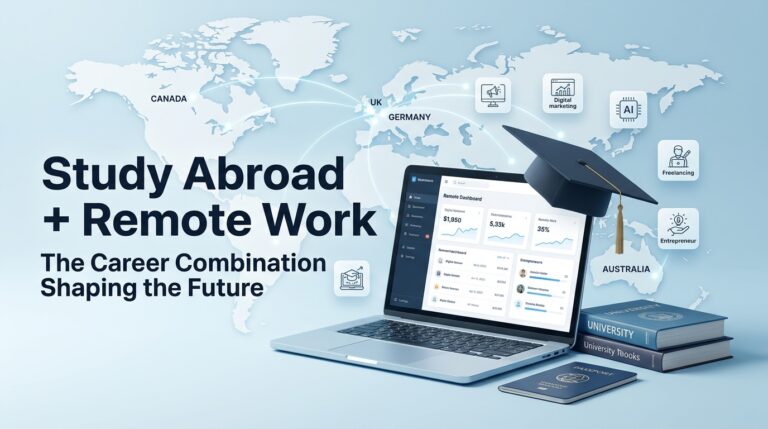
The traditional purpose of studying abroad is changing rapidly.
For many years, international education was mainly viewed as a pathway to earning a degree, finding employment, and potentially securing long-term residency in another country. While these goals remain important, students in 2026 are approaching global education with a much broader perspective.
Today’s students are not only investing in academic qualifications—they are building global careers while they study.
The rise of remote work, digital entrepreneurship, artificial intelligence, and online business opportunities has created a new reality. Students can now gain international education while simultaneously developing professional experience that is not limited by geography.
Across major study destinations such as Canada, Australia, the United Kingdom, Germany, and Europe, students are increasingly participating in:
✔️ Remote internships with international companies
✔️ Freelancing and project-based work
✔️ AI and technology-related opportunities
✔️ Content creation and personal branding
✔️ Digital marketing and online services
✔️ E-commerce and global entrepreneurship ventures
This represents one of the biggest shifts in modern career development.
Previous generations often relied on a single employer, a single country, or a traditional career path. Today’s students are building multiple skills, diverse income streams, and international professional networks long before graduation.
The advantage of studying abroad now extends far beyond the classroom.
An international education can provide access to:
🌍 Global exposure and cultural understanding
🤝 International professional connections
💻 Worldwide clients, employers, and collaborators
📍 Location-independent career opportunities
📈 Access to emerging digital industries
As industries continue to evolve, employers increasingly value adaptability, practical skills, and global awareness alongside academic qualifications.
The professionals most likely to succeed in the coming years will be those who can continuously learn, adapt to technological change, work effectively in digital environments, and create opportunities across multiple markets.
This is why many students are now focusing on developing complementary skills alongside their degree programs. Digital literacy, communication skills, AI knowledge, remote collaboration, and entrepreneurial thinking are becoming just as important as academic performance.
The reality is that a degree alone is no longer the complete competitive advantage it once was.
The real value comes from combining quality education with practical experience, international exposure, digital capabilities, and the ability to work across borders.
As the future of work becomes increasingly global and technology-driven, students who can blend education with real-world experience will be better positioned for long-term success.
The future belongs to individuals who can learn globally, work digitally, and create opportunities without being limited by geography.
In 2026 and beyond, success is not defined only by where you study—it is defined by how effectively you use the opportunities that studying abroad creates.