
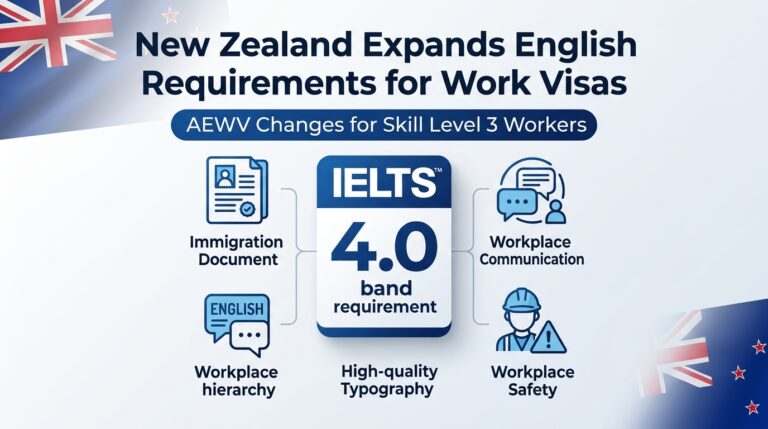
New Zealand has introduced an important immigration change in 2026 that will affect many foreign workers planning to apply under the Accredited Employer Work Visa (AEWV) program.
Immigration New Zealand (INZ) has announced that English language requirements will now extend to ANZSCO Skill Level 3 occupations, significantly expanding the number of workers who must demonstrate English proficiency before receiving a work visa.
Previously, English language testing requirements primarily applied to Skill Level 4 and Skill Level 5 roles. Under the updated framework, many mid-skilled occupations will now also be subject to language requirements, making English preparation an increasingly important part of the visa process.
This change impacts a wide range of occupations across sectors such as trades, technical services, construction, maintenance, hospitality, and other skilled workforce categories that fall under ANZSCO Skill Level 3 classifications.
Under the new rules, applicants must demonstrate a basic level of everyday English that allows them to communicate effectively in the workplace and within the community.
For most applicants, this means achieving a minimum IELTS overall band score of 4.0 or providing an equivalent result from another approved English language test accepted by Immigration New Zealand.
According to INZ, the purpose of the policy is to improve workplace communication, strengthen health and safety outcomes, help migrant workers better understand their employment rights and responsibilities, and support smoother integration into New Zealand society.
Clear communication is considered increasingly important across many industries where workers interact with employers, colleagues, customers, and regulatory requirements on a daily basis.
Importantly, the new language requirements do not apply to all occupations.
Workers employed in higher-skilled ANZSCO Skill Level 1 and Skill Level 2 occupations remain exempt from English language testing requirements under the current AEWV framework.
For employers, the update means recruitment planning may require additional preparation, particularly when hiring overseas candidates for mid-skilled positions. Applicants who previously focused only on job offers and employer sponsorship will now also need to ensure they meet language requirements before proceeding with their visa applications.
This development represents one of the most significant changes to the AEWV program in 2026 and highlights New Zealand’s growing focus on workforce quality, compliance, and long-term settlement outcomes.
The key message for prospective migrants is simple: English language preparation should now be considered an essential part of the work visa process, not an afterthought.
Applicants who prepare early, meet language requirements, and maintain complete documentation will be better positioned for a successful New Zealand work visa application and a smoother transition into the New Zealand workforce.