
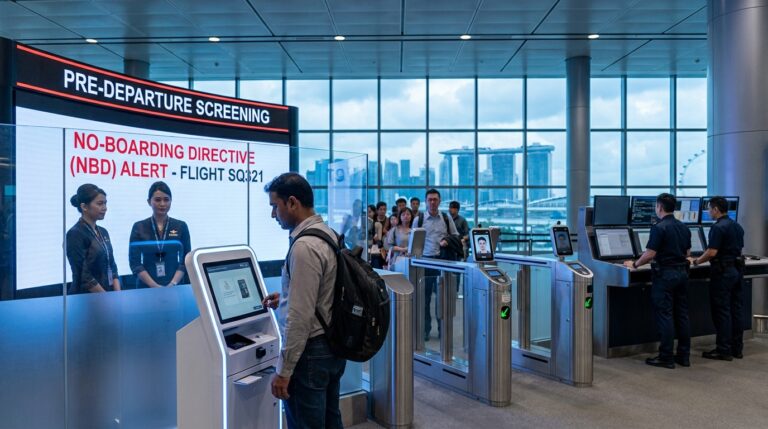
Singapore has entered a new phase of immigration enforcement in 2026, introducing stricter pre-departure screening measures and expanding its use of automated border technology. The country’s immigration system is now increasingly focused on risk assessment, biometric verification, and compliance checks before travellers even board their flight.
The latest reforms by the Immigration & Checkpoints Authority (ICA) reflect Singapore’s broader strategy to strengthen border security while maintaining efficient travel and immigration processes.
Major Change: No-Boarding Directive (NBD) System
One of the most significant developments in 2026 is the implementation of the No-Boarding Directive (NBD) framework.
Under this system, the ICA now has authority to instruct airlines to deny boarding to certain passengers before departure if immigration concerns are identified during pre-screening.
This means travellers may now be stopped before entering the aircraft itself — even before reaching Singapore immigration checkpoints.
Passengers May Be Denied Boarding If They:
- Do not meet entry requirements
- Have incomplete or inconsistent documentation
- Present suspicious travel patterns
- Are identified as high-risk during immigration screening
- Submit inaccurate arrival information
- Face unresolved visa or travel condition issues
This marks a major shift from traditional border control systems where most checks happened only upon arrival.
Why Pre-Departure Compliance Is Now Critical
Singapore’s immigration authorities are increasingly relying on digital systems, advance passenger information, and biometric verification to assess travellers before travel begins.
As a result, even small mistakes may now lead to serious travel disruptions.
Travellers Should Carefully Ensure:
- Passport validity fully meets Singapore requirements
- SG Arrival Card details are accurate and complete
- Visa status and travel conditions are verified before departure
- Travel history and supporting documents remain consistent
Incorrect declarations, mismatched information, or missing details may now trigger boarding refusal directly at the airport of departure.
Automated Immigration Clearance Expanding
Singapore is also rapidly expanding automated immigration processing at its borders.
At Changi Airport, automated clearance systems are now becoming standard for many travellers, including certain first-time visitors.
Key Features Include:
- Facial biometric verification
- Iris recognition technology
- Automated immigration lanes
- Reduced manual passport checks
The goal is to create faster passenger movement while simultaneously increasing immigration security and identity verification accuracy.
Workforce & Residency Policy Changes in 2026
Alongside stricter travel screening, Singapore has also updated several employment and residency policies.
Employment Pass & S Pass Changes
Salary thresholds for Employment Pass (EP) and S Pass applications have been revised upward in 2026, continuing Singapore’s focus on attracting highly skilled foreign professionals.
The government remains focused on:
- Higher-skilled workforce participation
- Economic contribution
- Long-term labour market sustainability
Permanent Residency & Citizenship Strategy
Singapore continues maintaining a controlled and selective residency framework.
Current annual intake targets remain approximately:
- 25,000–30,000 Permanent Residency (PR) approvals
- Around 30,000 citizenship approvals per year
Priority continues to be given to:
- Skilled professionals
- Long-term residents
- Individuals contributing to Singapore’s economy and society
Important Reminder for Indian Travellers
Indian passport holders still require a valid Singapore visa unless they qualify under limited Visa-Free Transit Facility (VFTF) arrangements.
Travellers should avoid relying on assumptions regarding transit eligibility and carefully verify visa requirements before booking travel.
A Shift Toward Data-Driven Immigration Enforcement
Singapore’s 2026 immigration model clearly reflects a shift toward data-driven border control and predictive risk management.
Immigration screening is no longer limited to physical checkpoints. Authorities are now assessing traveller profiles, documentation accuracy, biometric data, and travel intent before arrival itself.
This creates a system where preparation before travel becomes just as important as the visa approval process itself.
Final Insight
Singapore remains one of the world’s most efficient immigration systems, but it is also becoming one of the most compliance-focused and technologically advanced.
For travellers, students, workers, and visitors, the key message in 2026 is clear:
Successful entry into Singapore now depends not only on holding the correct visa or documents — but also on ensuring complete accuracy, consistency, and compliance before departure itself.