
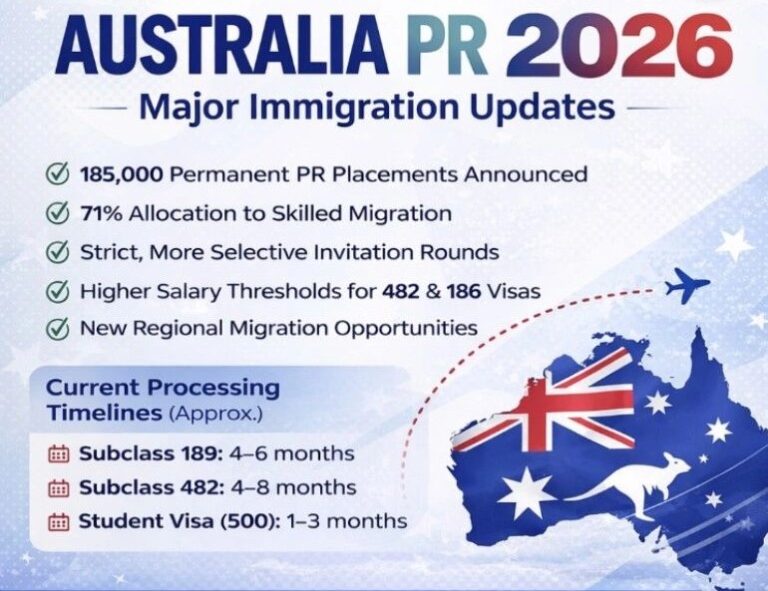
Australia’s 2026 migration strategy marks a decisive shift away from high-volume intake toward a precision-driven, economically aligned selection model. While the headline figure of 185,000 permanent migration places remains significant, the real change lies in how candidates are selected—not how many.
⚖️ Strategic Allocation & Policy Direction
Approximately 71% of migration places are allocated to Skilled Migration, reinforcing Australia’s focus on addressing targeted labour shortages rather than general intake.
Key structural priorities include:
- Occupation-focused invitations through SkillSelect
- Stronger emphasis on state and regional nominations
- Increased reliance on employer-sponsored pathways
- Continued investment in regional workforce distribution
This reflects a system designed to support economic productivity, infrastructure growth, and long-term workforce sustainability.
📊 Evolving Invitation Dynamics
Although the statutory minimum of 65 points under the points-tested system remains unchanged, it is no longer competitive in practice.
👉 Current invitation trends show:
- Higher cut-off scores across most occupations
- Priority given to healthcare, engineering, IT, and trades
- Increased selection through Subclass 190 (State Nomination)
- Strong preference for Subclass 491 (Regional Visas)
📌 Insight: Invitations are no longer score-driven alone—they are demand-driven and strategically filtered.
💼 Employer-Sponsored Migration Tightening
Visa subclasses such as 482 (Temporary Skill Shortage) and 186 (Employer Nomination Scheme) now operate under higher salary thresholds and stricter compliance checks.
This ensures:
- Fair wage protection
- Reduced misuse of sponsorship pathways
- Alignment with genuine skill shortages
👉 Employers must now meet stricter benchmarks, making sponsorship more selective but more credible.
🌏 Regional Migration as a Core Strategy
Regional Australia is no longer an alternative pathway—it is a central pillar of migration policy.
Benefits of regional pathways include:
- Priority processing
- Additional points for applicants
- Broader occupation lists
- Clearer transition routes to PR
📌 The government is actively redirecting migrants to regional areas to balance population growth and meet local workforce demands.
⏱️ Processing Efficiency & Digital Transformation
Australia continues to expand digital visa processing systems, improving efficiency in select categories:
- Subclass 189: ~4–6 months
- Subclass 482: ~4–8 months
- Subclass 500 (Student Visa): ~1–3 months
However, faster processing is increasingly linked to application accuracy and completeness.
⚠️ Legal & Strategic Insight
From a legal and advisory perspective, the 2026 system introduces higher scrutiny and lower tolerance for weak profiles:
- Generic applications face reduced success rates
- Incomplete or inconsistent documentation can lead to refusals
- Migration outcomes now depend on strategic positioning, not just eligibility
🎯 Final Takeaway
Australia’s migration system in 2026 is not closed—but it is highly selective.
✔️ Eligibility gets you into the system
✔️ Strategy gets you selected
Applicants must now focus on:
- Occupation relevance
- State or regional alignment
- Employer engagement
- Strong documentation and timing
👉 In today’s environment, a well-structured, demand-aligned profile is the key to securing an invitation—because migration is no longer about meeting the criteria, but about matching Australia’s future workforce needs.