
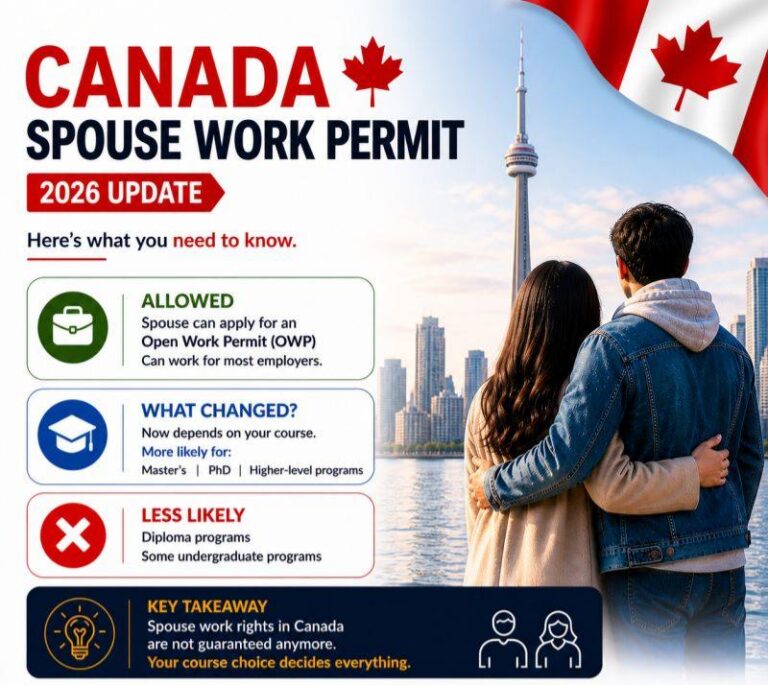
Planning to study in Canada with your spouse? The 2026 update has introduced a more targeted approach to spouse work permits, shifting away from broad eligibility to a program-based system.
Under policies managed by Immigration, Refugees and Citizenship Canada, spouses can still access work opportunities—but not every student pathway guarantees this benefit anymore.
🔍 What Is a Spouse Open Work Permit (OWP)?
A Spouse Open Work Permit (OWP) allows your partner to:
- Work for most employers across Canada
- Take up full-time or part-time employment
- Gain valuable Canadian work experience
👉 It remains one of the biggest advantages for international students choosing Canada.
✅ What Still Remains the Same
Despite the changes, some core benefits continue:
✔️ Spouses can still apply for an Open Work Permit
✔️ No job offer is required before applying
✔️ Work flexibility remains high across industries
👉 The pathway is still active—but now more selective
🆕 What Has Changed in 2026?
The biggest shift is this:
👉 Spouse work eligibility is now dependent on the student’s program level
This means:
- Your course choice directly affects your spouse’s ability to work
- Not all study programs provide equal immigration benefits
🎓 Programs More Likely to Qualify
Spouses are more likely to receive an OWP if the student is enrolled in:
- ✔️ Master’s degree programs
- ✔️ PhD programs
- ✔️ Selected high-level or professional academic programs
👉 These programs are viewed as high-value pathways with strong economic outcomes
⚠️ Programs That May Not Qualify
Eligibility becomes limited or uncertain if the student is enrolled in:
- ❌ Many diploma programs
- ❌ Certain undergraduate degrees
- ❌ Lower-level or short-term academic courses
👉 These programs may no longer automatically support spouse work rights
⚖️ Why This Change Matters
This update reflects a clear policy direction:
Canada is prioritizing:
- Skilled migration pathways
- Higher education outcomes
- Long-term economic contribution
👉 The system is moving from access-based immigration → to outcome-based selection
💡 Real Impact on Students & Families
This is not just a technical change—it directly affects life planning.
🔻 Financial Impact
- Reduced household income if spouse cannot work
- Increased financial burden on the student
🔻 Career Impact for Spouse
- Limited ability to gain Canadian work experience
- Potential gap in employment history
🔻 Decision Pressure
- Course selection now affects both partners, not just the student
🎯 Strategic Planning Is Now Essential
If you’re planning to study in Canada with your spouse, you must think beyond admission.
✔️ Before choosing a program:
- Check if it supports spouse work eligibility
- Prefer higher-level academic pathways if possible
✔️ Plan finances accordingly:
- Assume your spouse may not be able to work immediately
✔️ Align long-term goals:
- Choose programs that support PR pathways and career growth
⚠️ Common Mistake to Avoid
Many students still assume:
👉 “Spouse work permit is automatic”
Reality in 2026:
It is now conditional and selective
Ignoring this can lead to:
- Visa surprises
- Financial stress
- Limited work options for your partner
🧾 Final Insight
Canada continues to welcome international students and their families—but with a more structured and outcome-focused approach.
👉 Your course is no longer just an academic choice—it is a family-level immigration decision
✔️ The right program can open opportunities for both partners
✔️ The wrong one can limit work rights and financial stability