
Europe continues to remain one of the world’s most attractive destinations for international students. Countries across the Schengen region and the United Kingdom still offer globally recognised education systems, multicultural environments, and strong academic opportunities.
However, 2026 has brought a noticeable shift in immigration policy across several major European destinations. Governments are now placing greater focus on border control, financial transparency, and long-term immigration compliance. For international students, this means the application process is becoming more detailed, more monitored, and far less flexible than before.
Students who plan early and prepare accurate documentation will continue to have strong opportunities. But those relying on incomplete paperwork, weak financial evidence, or last-minute preparation may now face significantly higher refusal risks.
Europe Introduces Digital Biometric Border Monitoring
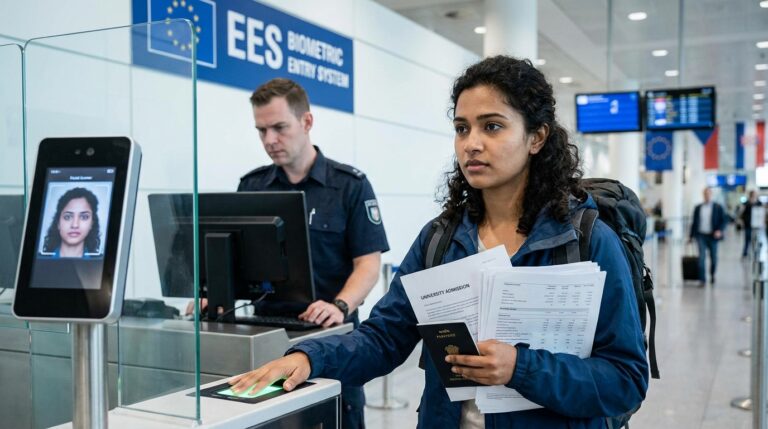
One of the biggest changes in 2026 is the full implementation of the Entry/Exit System (EES) across the Schengen Area.
The new system has now become active in 29 European countries and replaces traditional passport stamping with digital biometric tracking.
Under this framework, border authorities now collect:
- Facial recognition scans
- Fingerprint biometrics
- Automated digital travel records
This system is designed to monitor entry and exit movements more accurately, detect overstays, and strengthen immigration enforcement across Europe.
For international students, this means travel records and visa compliance are now being monitored much more closely than in previous years. Even small immigration violations may become easier for authorities to detect through integrated digital systems.
Financial Requirements Have Increased Significantly
Another major change affecting students in 2026 is the rise in financial proof requirements.
Many European countries now expect international students to demonstrate between €11,000 and €13,000 or more in verified living funds for a single academic year.
More importantly, immigration authorities are no longer reviewing only the final bank balance. They are now closely examining the source and movement of funds.
Countries such as Sweden, Finland, and Norway have increased scrutiny around financial histories, especially where applicants show:
- Sudden large deposits
- Unexplained money transfers
- Last-minute financial arrangements
- Unsupported family sponsorships
Immigration officers are increasingly looking for genuine financial stability rather than temporary account balances created solely for visa purposes.
Students should ensure that their financial documents clearly show consistent income patterns, legitimate savings history, and transparent sponsorship arrangements before submitting an application.
Ireland Tightens Student Visa Financial Rules
Ireland has also updated its student visa framework with stricter financial and procedural requirements.
Students must now demonstrate a minimum of €10,000 in living funds for their first academic year. In addition, applicants are expected to show at least €6,000 in tuition fee payments upfront before the visa decision process.
Biometric enrolment has also become mandatory for many applicants through authorised VFS centres.
These changes reflect Ireland’s increasing focus on ensuring students are financially prepared before arriving in the country.
United Kingdom Moves Fully Toward Digital Immigration Systems
The United Kingdom has continued its transition toward a fully digital immigration structure in 2026.
Physical BRP cards are gradually being phased out and replaced with electronic e-Visas linked directly to passport and immigration records.
The government has also updated maintenance fund requirements for international students:
- £1,171 per month for students outside London
- £1,529 per month for students studying in London
At the same time, the UK has confirmed upcoming changes to post-study work rights. From 2027 onward, Bachelor’s and Master’s graduates will generally receive only 18 months under the Graduate Route instead of the current 2-year period.
Another important restriction affects dependants. Most international students are no longer permitted to bring family members unless they are enrolled in eligible postgraduate research programs.
This marks a significant shift toward more controlled student migration policies.
Sweden Considering Stricter Student Work Limits
Sweden is also discussing tighter compliance measures for international students.
Current proposals include limiting students to a maximum of 15 working hours per week during academic sessions, along with stronger monitoring of academic progress and attendance.
Although these changes are still under discussion, they reflect a broader European trend toward ensuring that student visas are used primarily for genuine education purposes rather than indirect migration pathways.
Immigration Compliance Is Now More Important Than Ever
The overall direction across Europe is clear. Countries are still welcoming international students, but immigration systems are becoming increasingly selective and compliance-focused.
Today’s student visa applications are no longer assessed only on admission letters or tuition payments. Authorities are now reviewing the entire applicant profile, including:
- Financial credibility
- Academic consistency
- Long-term study intentions
- Immigration history
- Supporting documentation accuracy
Students who approach the process strategically, honestly, and professionally will continue to have excellent opportunities across Europe.
Final Thoughts
Studying in Europe still offers tremendous academic and career benefits, but the immigration environment in 2026 is far more regulated than before.
Digital border systems, stricter financial reviews, and tighter compliance rules are changing how student visas are assessed across major destinations.
For students, the message is simple: preparation matters more than ever.
Strong documentation, verified financial history, realistic study plans, and full transparency are now essential parts of a successful European student visa application.